FARMS FOR COMPUTATIONAL SCIENCE

A verifiable
foundation for
computational science.

Turning mathematical literature into faithful, reusable knowledge for scientific computing.

Di Wu · Ling Liang · Haizhao Yang*

University of Maryland, College Park
The University of Tennessee, Knoxville

FROM LITERATURE TO COMPUTATION01—03
01

SOURCE CONTEXT

Mathematics has conditions.

Objects · assumptions · algorithms

ℰ(t) = ℰ(0) for t ≥ 0
02

FORMAL REPRESENTATION

Make the conditions explicit.

∀ t : ℝ, 0 ≤ t →
  totalEnergy Ω u t =
  totalEnergy Ω u 0 := by sorry
Wave-energy statement · proof omitted
03

COMPUTATIONAL USE

Reason about accuracy.

Heat-flow solveWave compression

Source premises + checked connecting implications

171targets studied
4mathematical sources
157accepted statements*
2computational applications

* Includes 3 source-warning outcomes. Acceptance is about statement construction, not completed proofs. See reported results →

01 / THE IDEA

Keep the mathematics
that makes a method work.

A formula alone does not tell you when an algorithm can be trusted.

Its guarantee depends on the objects, assumptions, sampling rules and error measure around it. FARMS brings this context into a formal representation, so the conditions for computational reuse are available for inspection.

Objects What is being computed?Conditions When does the method apply?Guarantees What accuracy can be claimed?

02 / THE METHOD

From source evidence
to reusable statements.

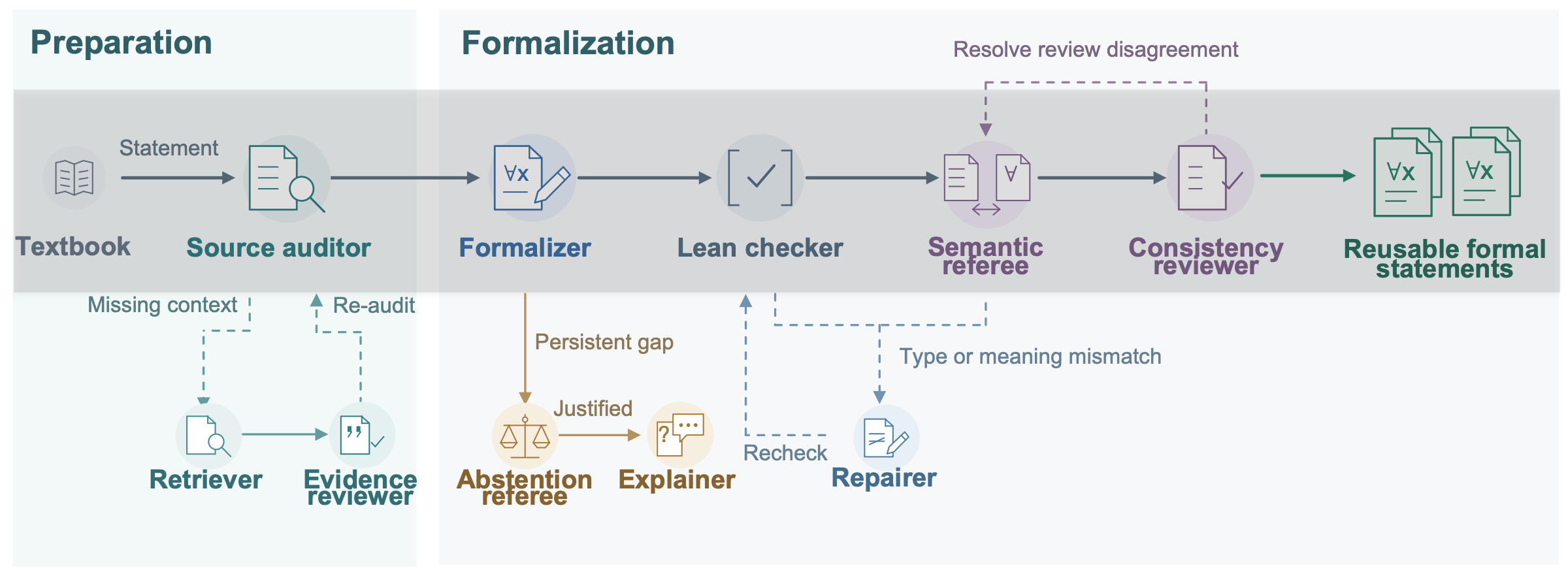
Preparation recovers context. Formalization makes it explicit. Compilation and semantic review examine different parts of the result.

A

Preparation

Recover the context behind a claim.

B

Formalization

Construct, check, review and repair.

Reusable
formal statements

Explicit assumptions.
Source-linked meaning.
Documented limitations.

SELECT A ROLE TO EXPLORE

Source auditor

Checks whether the claim has enough definitions, assumptions and algorithmic context to be interpreted.

FARMS framework: source preparation, formalization and semantic review build reusable mathematical statements.
FARMS connects source context, formal statements and computational use. Full figure (PDF) ↗

03 / WHY FAITHFULNESS MATTERS

Small conditions.
Different guarantees.

See how restoring an assumption changes a guarantee, and how a counterexample disproves a source claim.

CASE A / RECOVERING CONDITIONS

Can the algorithm
produce a valid output?

‖A − UUᵀA‖ꜰ ≤ (1 + ε) ‖A − Aₖ‖ꜰ

An algorithmic accuracy guarantee

The success event must include existence of a valid output, as well as its approximation quality.

The rank and logarithm-domain conditions determine when the algorithmic guarantee applies.

CASE B / A SOURCE DEFECT

A sampling-optimality claim
disproved by a counterexample.

Source claim: E(p*) ≤ E(q) for every admissible q

A claim about exact expected error

This claim is false on the stated probability domain, which allows zero probability on nonzero matrix contributions.

Explore the counterexample →

04 / FROM STATEMENTS TO COMPUTATION

Mathematical knowledge.
Computational decisions.

Selected source premises and Lean-checked connecting implications guide two numerical applications.

APPLICATION 01NUMERICAL SOLVING

Steady heat flow

When is an iterative solve accurate enough?

Heterogeneous conductivity · schematic

22updates in each of six reported runs

A Gaussian sketch supplies a preconditioner. The original system’s residual determines whether the relative energy-error target of 10⁻⁶ has been reached.

Conductivity contrasts
100 / 1,000
Unknowns
512
Sketch rows
2,048

The sketch is an auxiliary operator; it does not reduce the number of unknowns.

Explore the Gaussian-bound premise →
APPLICATION 02RESPONSE REUSE

Wave-response compression

Can a smaller response library meet a fixed error bound?

Prescribed excitation family · schematic

384 → 128excitation channels → basis responses

Energy conservation and a checked matrix residual bound control response error for all allowed combinations and nonnegative times under the stated model assumptions.

Response library
24 → 8.375 MiB
Absolute energy-error target
0.01
Query coefficients
‖α‖₂ ≤ 1

A saved-factor check supports reuse within this prescribed family, not arbitrary excitations.

Explore the wave-energy premise →

Connecting proofs establish implications from explicit source premises and application assumptions. They do not supply omitted proofs of those source statements.

View the application figure (PDF) ↗

05 / RESEARCH RESULTS

Formalization results.
Across two domains.

Randomized numerical linear algebra and numerical PDEs, drawn from four mathematical sources.

Formalization results across four mathematical sources
Mathematical sourceTargetsAcceptedWith warning*Not accepted
Drineas & MahoneyLectures on randomized numerical linear algebra322814
Halko, Martinsson & TroppFinding structure with randomness353213
Martinsson & TroppRandomized numerical linear algebra: Foundations and algorithms201614
Larsson & ThoméePartial differential equations with numerical methods848103
Total171157314

* The 3 source-warning acceptances are included in the 157 accepted statements. The sampling-optimality source defect is excluded from the accepted results.

$0.85–2.29mean estimated cost per target, across sources

Across 171 targets, FARMS produces 157 accepted formal statements. Explore accepted statements and the assumptions that connect them to computation.

Explore the statements →

START WITH THE MATHEMATICS

Read a statement.
Inspect its conditions.

Open the Formalization Explorer ↗

Explicit assumptions. Source-linked meaning. Computational use.